The Polar Vortex Is About to Break Down 3 Weeks Earlier Than Ever Recorded, and the East Could Feel It by Thanksgiving

Forecasters expect the polar vortex to break down in early November, weeks earlier than it ever has.

Weather models show the winds circling high above the North Pole slowing down and reversing around Nov. 4, which could split the vortex in two, Severe Weather Europe reported. The European ensemble gives that reversal a 96% chance. The American ensemble has it at 71%.

No major disruption has come this early since records began in 1959. The earliest so far happened on Nov. 28, in 1968 and again in 2025, according to polarvortex.earth, as cited by Capital Weather. This one would beat that by about three weeks.

“This will be, I think almost undoubtedly, the largest, earliest disruption of the polar vortex on record,” Judah Cohen, a research scientist at MIT, told Fox Weather.

What It Could Mean for the East

The polar vortex normally keeps the coldest air up near the Arctic. When it gets disrupted, some of that air can move south.

“We’re already seeing the polar vortex become distorted and stretched out,” Laura Ciasto, a meteorologist with the National Weather Service, told The Philadelphia Inquirer. She said these events “lead to increased probabilities of below-normal temperatures across the Eastern United States.”

The effects usually take a couple of weeks or more to reach the ground. The Inquirer reported that they could show up in the second or third week of November, possibly before Thanksgiving on Nov. 26.

After last year’s disruption in late November, the eastern U.S. had a colder-than-normal winter, according to Capital Weather.

Why It Might Not Turn Cold

The official forecast doesn’t show any cold yet. NOAA’s Climate Prediction Center favors above-normal temperatures across most of the country through Nov. 14. Only parts of the Southeast lean near or below normal.

El Niño is also in play, and it usually means milder winters for much of the U.S. “I’m thinking we may not see a response in North America,” Matt Rogers of the Commodity Weather Group told Capital Weather.

Ciasto said there have been so few of these events in November that “there’s some uncertainty about what the surface impacts might look like.”

Cohen said the same. “I don’t know what’s going to happen, and I don’t think anyone else does either,” he told Capital Weather.

In October, every major weather model already had the polar vortex heading for record-weak levels in early November. The latest forecasts show it breaking down altogether.

Go to Source
Author: Xavier Sintra
Scientists Followed 3,635 Adults for 12 Years and Found a Surprising Longevity Benefit

Reading a good book might do more than help you unwind. Researchers at Yale University found that adults who regularly read books had a 20 percent lower risk of death during a 12-year follow-up compared with people who didn’t read books.

The finding comes from a 2016 study published in Social Science & Medicine that examined 3,635 Americans over age 50. The research has attracted renewed attention in October 2026, raising an intriguing question: Could something as simple as reading help support a longer life?

Related: How Elite Longevity Testing Could Help You Live Healthier Longer, Research Suggests

Next: Scientists Found a Brain Skill Linked to Living Longer and It’s Not Memory

Why Books Had an Advantage Over Newspapers

Researchers compared book readers with people who preferred newspapers and magazines. Both activities involved reading, but books showed a stronger association with survival.

The researchers also accounted for age, education, wealth, existing health conditions, and other factors that might influence survival.

Their findings suggest that the type of material people read could matter, not merely the time spent reading.

Next: Your Gut May Hold a Surprising Clue to How Fast Your Brain Is Aging

The Brain May Explain the Unexpected Connection

One possible explanation involves cognitive engagement.

Books often demand sustained attention, comprehension, and the ability to connect ideas across chapters. Researchers examined whether these mental processes might help explain the relationship between reading and survival.

Their analysis identified cognitive performance as a statistical mediator of the association.

However, the study was observational. It cannot establish that reading directly prevents disease or extends life.

That distinction matters because people who read regularly may differ from nonreaders in ways researchers cannot fully measure.

Next: Scientists Found a Daily Step Count Linked to Slower Alzheimer’s-Related Decline

How Much Reading Could Make a Difference?

The researchers divided participants into three groups: nonreaders, people reading up to 3.49 hours weekly, and those reading at least 3.5 hours.

Both reading groups demonstrated a survival advantage compared with nonreaders after statistical adjustments.

For perspective, 3.5 hours weekly works out to approximately 30 minutes daily.

That doesn’t establish a medically recommended reading prescription, but it offers a manageable starting point.

The Men’s Journal takeaway: Reading shouldn’t replace exercise, adequate sleep, or preventive healthcare. But setting aside half an hour for a book is an accessible way to stay mentally engaged—and potentially support healthier aging.

Next: Time-Saving Healthy Cooking Tips

Related: Scientists Found a Surprising Longevity Benefit From Lifting Weights

Go to Source
Author: Joseph Arangio

White Christmas Forecast Shows Snow Coming to Every US State

It’s never too early to start thinking about Christmas, especially when it comes to the weather. We’re still making our way through fall, but before long, Halloween decorations will come down, Christmas trees will go up and the annual question will start making the rounds: Will we have snow on the ground on Christmas morning?

There are a few numbers worth looking at before making any holiday-weather predictions. The National Weather Service has released historical data showing the odds of a white Christmas across the country, while AccuWeather has identified areas with a higher-than-average chance of seeing one this year. According to AccuWeather senior meteorologist Chad Merrill, much of the Mountain West is among the places with better prospects for a snowy holiday.

What Actually Counts as a White Christmas?

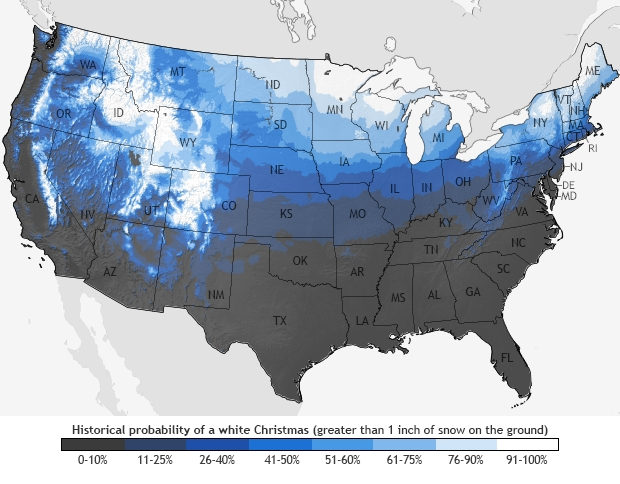
The National Weather Service’s Climate Prediction Center has a National White Christmas Map that provides a look at how likely different parts of the country are to have snow on the ground on Dec. 25. It’s based on climate averages from 1981 through 2010, giving us a 30-year look at typical Christmas weather rather than a prediction for any particular year.

There’s also a specific measurement behind the term. To qualify as a white Christmas on the map, a location needs to have at least 1 inch of snow on the ground Christmas morning. Snow falling during the day doesn’t necessarily count if it doesn’t leave that much accumulation behind.

The distinction matters because a few flakes in the air aren’t quite the same as waking up to a blanket of snow. The historical information comes from NOAA’s National Climatic Data Center and gives readers a way to compare the normal odds from one part of the country to another.

The National Weather Service also provides more localized information for parts of the Midwest, including Eastern Iowa, Northwest Illinois and extreme Northeast Missouri. Those figures use the same 1981-2010 climate averages.

The Mountain West Has Better Odds This Year

The historical map shows a clear difference between the northern and southern portions of the country. The Upper Midwest and Upper Northeast have traditionally had some of the strongest chances of having snow on the ground Christmas morning. Parts of the Northwest and the mountain regions also stand out.

Merrill’s outlook from AccuWeather adds another reason to keep an eye on the Mountain West. The forecast service identifies much of that region as having a higher probability than average of seeing a white Christmas this year. That’s an important aspect to notice: The historical map shows what has typically happened over several decades, while AccuWeather is highlighting areas with better-than-average prospects for this year’s holiday.

The southern states generally have a much tougher path to a snowy Christmas. Florida sits near the bottom of the historical map, with very little chance of having an inch of snow on the ground by Christmas morning. The contrast between the northern and southern parts of the country is pretty hard to miss.

Of course, none of this guarantees that a particular town will wake up to snow on Dec. 25. Christmas weather can change from year to year, and the historical map isn’t designed to predict conditions months in advance. Still, between the long-term climate data and AccuWeather’s outlook, there’s already a good reason for some parts of the country to start getting excited about the possibility of a white Christmas.

Go to Source
Author: Anne Erickson

How to Watch Ravens vs. Bills: TV Channel, Live Stream, Time

The Baltimore Ravens visit the Buffalo Bills in Week 8 of the 2026 NFL season on Sunday, Nov. 1, 2026, at 1 p.m. ET from Highmark Stadium in Orchard Park, New York. Buffalo has lost once this season, at home, and Baltimore is 3-1 away from home. The Bills are 5-1, lead the AFC East and come out of their Week 7 bye. The Ravens are 4-3 and fourth in the AFC North. Buffalo’s loss was a 29-26 decision against New England in Week 4, and the Bills allow 28.5 points per game, a bottom 10 mark. Baltimore comes in off a 35-13 home loss to Cincinnati in Week 7, but it runs for 142 yards per game, a top 10 mark. Below are the details on how to watch. How to Watch Ravens vs. Bills Players To Watch Baltimore went 1-2 with Tyler Huntley starting while an ankle injury kept Lamar Jackson out of Weeks 5 through 7, and he is expected back Sunday. He was averaging 10.1 yards per attempt before he got hurt, and Buffalo allows 286 passing yards per game, a bottom 10 mark. The ankle is the question. Jackson ran for 144 yards in four games, and how freely he uses his legs will show how healthy he is. Buffalo has only 11 sacks in six games, so the pocket should give him time to throw. His first designed run will tell you a lot about the Ravens’ confidence in him. Zay Flowers averages 101 receiving yards per game, No. 2 in the NFL, and he kept producing with Huntley at quarterback, catching eight passes for 137 yards in the Week 7 loss to Cincinnati. Jackson’s return gives him a quarterback who can push the ball again, and Buffalo allows 387 total yards per game, a bottom 10 mark. Flowers’ 311 yards after the catch rank second in the league, so the Bills have to tackle in space to keep short throws short. Count how many of his catches turn into gains of 15 yards or more. Buffalo comes out of its bye scoring 32.8 points per game, the most in the NFL, and Josh Allen’s eight rushing touchdowns are tied for the league lead. He averages 8.8 yards per pass attempt, so he is hurting defenses both ways. Baltimore’s pass rush has not created much pressure, with 12 quarterback hurries, a bottom 5 total. That gives Allen time to extend plays, and the Ravens allow 221 passing yards per game. His legs near the goal line are the problem Baltimore has to solve, so his red-zone carries are the place to look. James Cook III has scored in five straight games, and he accounts for 105 of Buffalo’s 149 rushing yards per game, No. 2 in the NFL. Baltimore is a tougher test, allowing 97 rushing yards per game, a top 10 mark. The Ravens have forced five fumbles, and Cook put the ball on the ground twice in the Week 5 win at the Rams, losing one. Buffalo can use him to keep Jackson on the sideline, so ball security matters as much as yards against this front. His carry total in the second half is worth tracking. Ravens vs. Bills Odds Learn more about Baltimore Ravens vs. Buffalo Bills and check the full schedule on FOX Sports! Want great stories delivered right to your inbox? Create or log in to your FOX Sports account, follow leagues, teams and players to receive a personalized newsletter daily.

Go to Source
Author: